I am very pleased to be able to announce that I have decided on a brand new project for 2015/16. By that, I mean something to get my teeth into that I might actually finish and that I will actually game (as opposed to all the nice things that I have models for 'cos I like them, but currently have little chance of gaming, e.g Wars of the Roses, French Indian War).
This will be an Indian Mutiny project for The Men Who Would Be Kings. The aim is to have two sizeable forces completed by the time the rules are officially released in August 2016.
The forces will comprise a mixture of units from Mutineer Miniatures and the upcoming range from Iron Duke Miniatures as sold by Empress Miniatures. This means that I will be able to use models from two of my favourite sculptors, Paul Hicks (whose marvellous Empress British Colonial infantry are the 'Suffolk Regt' in my NW Frontier Games) and Mike Owen.
Using the two ranges means I will get the best of both worlds, as Mike Owen is a master of characterful 'character' models and the 'at the ready' and 'march attack' type poses (although IMHO, his firing poses are never quite right) and Paul seems to just have a fabulous eye for great poses - his 'firing pose' figures are superb (check out my 'Suffolks' for proof of that) and he also produces some great models in other poses too. Check out the (currently small) gallery on the Iron Duke website here for initial releases in the range. Also, check out the workbench here...those Sikhs!!! Wow!!
The 'backstory' for my forces is a British Field Force attempting to overthrow the Rani of Rhanjipur (a fictional personage and locality not so loosely based on the real Rani of Jhansi in the Mutiny...look her up) in late 1857/early 1858. This means that all my British troops can be armed with the Enfield Rifle and, as the campaign starts in the 'cold season', I can have a wide range of uniform colours for the Brits, including at least one red coated unit (whereas a summer campaign would see them all in white/dyed various early khaki shades). The story is that rebel fugitives from Delhi have persuaded the (hitherto undecided) garrison regiments in Rhanjipur to rebel. The rebellious Sepoys look to the Rhani for leadership, as they know that she harbours a deep dislike of the British as she has been ill-treated by them since the demise of her husband and, being a woman of remarkable temper and blessed with the personality of command, she is a natural choice to lead...
I have been interested in this period since I was a teenager but have never been able to find a reason to game it. TMWWBK is giving me an excellent excuse to finally put together the forces and have a bash and these new ranges are 'the dog's flopsy bits!!!' (err...that means they area a 'bit good' for those of you to whom English is not a first language or to whom such imagery is unfamiliar!!)
The first order has just gone to Mutineer Miniatures for a bunch of rebellious Sepoys, The Rani and friends and a few of her own private army of matchlock men...
Exciting times!! I will also continue to work on the later Colonials as I still need to get more stuff on the table for that. British artillery and more Pathan Swordsmen will hopefully be complete early next week if not before...
Monday, 13 April 2015

Saturday, 4 April 2015
Colonial Updates
Since my last post, we have put in a fair few hours on The Men Who Would Be Kings play tests. We have tried another couple of scenarios, one involving the defence of a static object (we chose a waterhole) and the other a 'remnants of a defeated force retreating to safety' scenario (Maiwand, anyone?)
Once again, we found that the main rule mechanisms enabled us to have extremely enjoyable games. In both scenarios, we tweaked the abilities of the Ghazis to better suit their role on the NW Frontier - a great feature of the rules being that players are encouraged to use their 'theatre-specific' knowledge to help to customise their forces appropriately. In all games, we have found that rolling for unit leadership traits has added some good 'colour' to the games without completely b*ggering up the scenario or spoiling anyone's fun (even if the roll leads to dodgy traits, it all seems to add to the fun factor.)
Thus far, we are finding that the scenarios are balancing the forces quite well, although the Pathans are thus far ahead in their victories - the British have only won one of the play test games and that by virtue of the fact that they were actually able to deploy into a proper line and shoot the living daylights out of the enemy. Having said that, in most other games, the Pathans have suffered heavily in their victories, which feels about right!
Overall, we love these rules. They are good fun and give a lot of 'cinematic period feel'. A minor handful of folk following my progress on the Lead Adventure Forum (I have posted bat reps there) have muttered about a few things, but in general, they seem to be players who probably either moan about every set of rules and just enjoy being negative or are the sort of players who prefer a more 'historical simulation' type of rule set. I personally think that anyone who enjoys a fun evening's gaming with well thought-out scenarios, excellent 'feel' for the period and a hefty does of humour will love TMWWBK when it comes out next year. Players who approach things in an overly 'serious' manner or who like 'nit-picky' rule systems may wish to look elsewhere...
Here are a few pics from the recent games...
The 'Defend the Waterhole' scenario: (Full report here.) Essentially, the Sikhs held the waterhole for most of the game before being shot down by Pathan sharpshooters. The Pathan swordsmen shot their bolt too early and were cut down by massed gunnery from the Brits and Gurkhas. In the end, the Pathans were unable to achieve their objective ion the face of the British fire.


Retreat from Maiwand. (Full report here.) In this game, the Pathans out-generalled the Brits, by slowing them down with relentless sniping, finally over-running the remnants with swordsmen, although the Gurkhas stubbornly held out and inflicted heavy casualties.


 More Pathan reinforcements and a British mountain Gun are almost painted and will be in the next game...
Once again, we found that the main rule mechanisms enabled us to have extremely enjoyable games. In both scenarios, we tweaked the abilities of the Ghazis to better suit their role on the NW Frontier - a great feature of the rules being that players are encouraged to use their 'theatre-specific' knowledge to help to customise their forces appropriately. In all games, we have found that rolling for unit leadership traits has added some good 'colour' to the games without completely b*ggering up the scenario or spoiling anyone's fun (even if the roll leads to dodgy traits, it all seems to add to the fun factor.)
Thus far, we are finding that the scenarios are balancing the forces quite well, although the Pathans are thus far ahead in their victories - the British have only won one of the play test games and that by virtue of the fact that they were actually able to deploy into a proper line and shoot the living daylights out of the enemy. Having said that, in most other games, the Pathans have suffered heavily in their victories, which feels about right!
Overall, we love these rules. They are good fun and give a lot of 'cinematic period feel'. A minor handful of folk following my progress on the Lead Adventure Forum (I have posted bat reps there) have muttered about a few things, but in general, they seem to be players who probably either moan about every set of rules and just enjoy being negative or are the sort of players who prefer a more 'historical simulation' type of rule set. I personally think that anyone who enjoys a fun evening's gaming with well thought-out scenarios, excellent 'feel' for the period and a hefty does of humour will love TMWWBK when it comes out next year. Players who approach things in an overly 'serious' manner or who like 'nit-picky' rule systems may wish to look elsewhere...
Here are a few pics from the recent games...
The 'Defend the Waterhole' scenario: (Full report here.) Essentially, the Sikhs held the waterhole for most of the game before being shot down by Pathan sharpshooters. The Pathan swordsmen shot their bolt too early and were cut down by massed gunnery from the Brits and Gurkhas. In the end, the Pathans were unable to achieve their objective ion the face of the British fire.
Retreat from Maiwand. (Full report here.) In this game, the Pathans out-generalled the Brits, by slowing them down with relentless sniping, finally over-running the remnants with swordsmen, although the Gurkhas stubbornly held out and inflicted heavy casualties.
Sunday, 1 March 2015
More Colonial Fun...
So, a couple of weeks ago, Andy MacTaggart and I reconvened chez moi to have another bash at 'The Men Who Would Be Kings'. As per the previous game, the scenario was set on India's NW Frontier at the end of the 19th Century.
Since the previous game, I had managed to paint some extra troops, so the Anglo Indians were joined by a unit of Gurkhas and the Pathans had extra riflemen.
This time, we tried some upgrades, so the British troops had an upgrade to enable them to hit on 4+ in shooting (to represent the magazine rifles they had in the 1897 conflict), the Sikhs had an upgrade to enable them to fight better and the Gurkhas an experimental rule to allow them to ignore difficult ground.
The Pathans had a unit of Ghazis who also were upgraded so they fought better and one riflemen unit was upgraded to shoot better as well.
The scenario saw the Anglo Indian force patrolling the hills and the Pathans trying to prevent them doing it. The Pathans had some clever hidden deployment rules for all bar one riflemen unit.
The leadership rolls saw all the Pathans with ridiculously good leadership and the British with average leadership. This was to make a big difference in the game, as the Pathans resolutely refused to become pinned under British fire, while the constant trickle of casualties from Pathan rifle fire whittled the Anglo-Indians away. Eventually, the Anglo-Indians did manage to patrol 3 out of 6 areas of the board, but were forced into a dramatic last stand, where the British unit, although cut down to the last man, inflicted such casualties on the Pathans that the game result was a draw!!
It was a great game and, although Dan has since tweaked the rules, there were no massive issues. In fact, the tweaks he has made will make the rules even better.
Poor lighting in my kitchen-diner makes the pics a bit rubbish, but here are a few...
Shortly after the game, the weather cleared, allowing photography outside, so I took several pics of the collection as it stands, minus one unit of Pathans who needed highlights and the final touches to basing, although they had played in the game in their unfinished state...


I'm really pleased with the way the scenery worked out - a bit of delicate balancing of aquarium features and a very large old Last Valley desert hill...
'Pinned' markers (or 'Suppression' markers for Triumph & Tragedy) coming next along with a Mountain gun...
Since the previous game, I had managed to paint some extra troops, so the Anglo Indians were joined by a unit of Gurkhas and the Pathans had extra riflemen.
This time, we tried some upgrades, so the British troops had an upgrade to enable them to hit on 4+ in shooting (to represent the magazine rifles they had in the 1897 conflict), the Sikhs had an upgrade to enable them to fight better and the Gurkhas an experimental rule to allow them to ignore difficult ground.
The Pathans had a unit of Ghazis who also were upgraded so they fought better and one riflemen unit was upgraded to shoot better as well.
The scenario saw the Anglo Indian force patrolling the hills and the Pathans trying to prevent them doing it. The Pathans had some clever hidden deployment rules for all bar one riflemen unit.
The leadership rolls saw all the Pathans with ridiculously good leadership and the British with average leadership. This was to make a big difference in the game, as the Pathans resolutely refused to become pinned under British fire, while the constant trickle of casualties from Pathan rifle fire whittled the Anglo-Indians away. Eventually, the Anglo-Indians did manage to patrol 3 out of 6 areas of the board, but were forced into a dramatic last stand, where the British unit, although cut down to the last man, inflicted such casualties on the Pathans that the game result was a draw!!
It was a great game and, although Dan has since tweaked the rules, there were no massive issues. In fact, the tweaks he has made will make the rules even better.
Poor lighting in my kitchen-diner makes the pics a bit rubbish, but here are a few...
 |
| Set-up...Pathan riflemen left centre. Cattle and small rocky outcrops are the 'patrol areas' the Brits need to check out... |
 |
| View from behind the Pathan riflemen... |
 |
| Pathan hidden deployment brings the Ghazis on behind the Sikhs! That cannot be good (if one is a Sikh!) |
 |
| Pathan riflemen deploy skulking in the rocks overlooking one of the patrol areas...sneaky blighters! |
 |
| View of the table after a couple of turns... |
 |
| The Sikhs activate and give the Ghazis a taste of Martini Henry medicine... |
 |
| View of the table as the Sikhs force the Ghazis back, losing many men in the process. Bottom right, The Gurkhas claim an objective and top right, The Brits do likewise... |
 |
| ...Success is short-lived, as Pathan reinforcements arrive and put severe pressure on the Gurkhas a Sikhs as they strive for the fourth objective... Two or three turns later, both Indian units were cut down. |
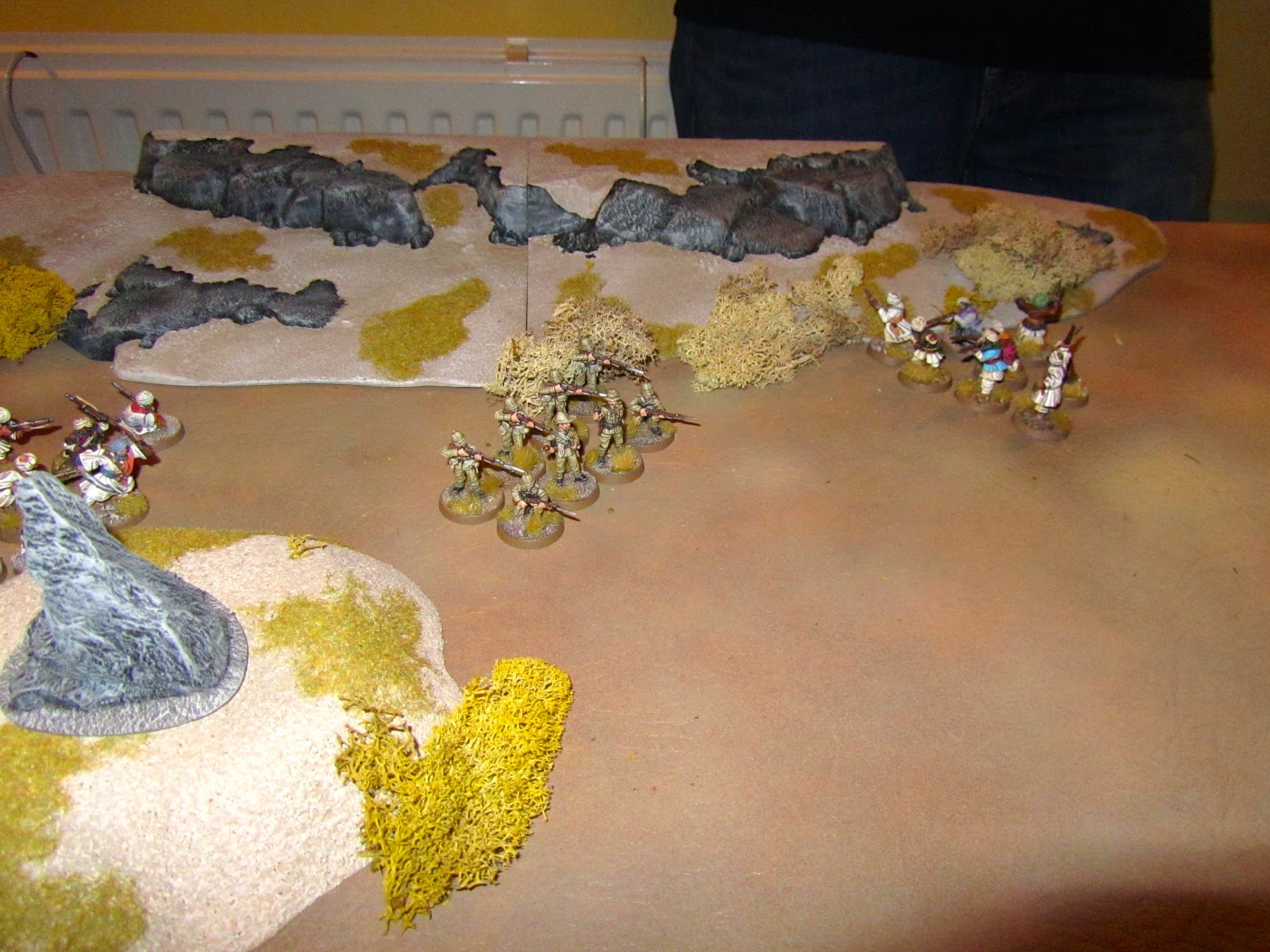 |
| The Suffolk Regt face the inevitable, but their Lee Metford volleys cause fearful execution amongst the enemy... |
 |
| The end is now moments away...another valiant last-stand and more posthumous Victoria Crosses... |
Shortly after the game, the weather cleared, allowing photography outside, so I took several pics of the collection as it stands, minus one unit of Pathans who needed highlights and the final touches to basing, although they had played in the game in their unfinished state...
I'm really pleased with the way the scenery worked out - a bit of delicate balancing of aquarium features and a very large old Last Valley desert hill...
'Pinned' markers (or 'Suppression' markers for Triumph & Tragedy) coming next along with a Mountain gun...
Thursday, 12 February 2015
Playtesting Dan Mersey's Upcoming Colonial Rules - 'The Men Who Would Be Kings'
I am extremely fortunate to have been asked to help play test the upcoming Colonial 'large scale skirmish' rules by Dan Mersey (of Dux Bellorum and Lion Rampant fame). These are intended for publication by Osprey sometime nextI year, so we are in the early stages of play tests and Monday evening was my first foray into the rules.
Dan has asked play testers to be careful what we post online, as things can change so much in the course of play testing, but I have checked with him that it's ok to tell you the following:
The game has similarities to Lion Rampant in its design and in some of the game mechanics. Basically, each unit of troops/warriors has to 'activate' each turn. Some things it can do without any tests, but other, more unusual or complex things need to be tested for. This varies according to whether you are a regular soldier, a tribal warrior, etc.
Dan has made the troop types fairly generic, but with upgrade options to create forces based on historical campaigns, e.g. enabling warriors to be fanatical fighters, allowing upgrades to marksmanship, etc. This is good, as it prevents loads of different troop types to confuse and confound. He has opted for a similar approach to weaponry which is simple but incredibly effective, allowing for games from 1850 to 1900 without needing lengthy weapon tables. This is a feature of rules that Dan writes - he makes the core mechanics simple, but open to maximum player engagement and thus far, this set is working well along those lines.
Units depend on the quality of their leaders and there is a neat mechanism for varying quality of leaders in your forces. This is important, because the worse the leadership of the unit, the harder it is to rally if it is unfortunate enough to be pinned down under fire. Talking of which, shooting and combat are simple and brutal, but seem to work well. We tested this by charging a large tribal unit over open ground at a British firing line with predictable results - the warriors did make it into contact (we made them 'fanatics' so they had good leadership), but were so shot up that they were repulsed in the combat. We felt that this was good, as it means that a native player will have to use terrain in a cunning way to win! As we play NW Frontier/Afghanistan, this is perfect for our Pathans!!!
So to the test game, where we used what I have painted, which is a unit of 12 British infantry accompanied by a unit of 12 Sikhs against 2 units of 12 Pathan riflemen/jezzails and 2 units of 16 Pathan swordsmen. For the main game, we used no upgrades. These forces are effectively half the standard size that one would normally use, so we decided that we would play on a 4 x 4 foot table. We decided that the British would be trying to burn down the lovely Pathan watchtower that Jimbibbly James (Oshiro Model Terrain) made for me a while back, so plonked it in the centre of the table and rolled for leader qualities....REALLY BADLY!!! The British officer was clearly fresh out of Sandhurst and one of the Pathans had a tendency to smoke too much dope, thereby giving him variable leadership. One of the Pathan swordsmen units got a trait that meant they had to charge if they could - good - just what Ghazis should do!! So off we went...
The Anglo Indians advanced on the tower, with the British unit making a beeline for the door while the Sikhs took up a position to shoot the bejeezus out of the advancing Pathans on their (left) flank. The Pathans simply rushed forward to slay the infidels, hoping to do a wee bit of sniping when they came into range.
In the event, the British unit reached the tower but was forced to take refuge inside by hordes of Pathans while the Sikhs were left out in the open trying reasonably successfully to keep the remaining natives at bay (pinning is a real killer when you are a native unit with a dodgy leader!) In the event assaults and shooting gradually reduced the British unit until it became pinned inside the tower, needing to score 11 on 2 D6 to rally! At this point, despite driving off 2 Pathan attacks, the Sikhs, losing men and outnumbered, decided that they would have to leave the British to their fate inside the tower...we called it at that point as a Pathan victory.
The rules still need some tweaking regarding the effects of buildings on shooting and combat, but apart from that the game played out well. The Sikhs held off massed assaults (volley fire is NASTY!) and one dodgy decision (not getting into firing line quickly enough) saw the poorly led British unit take a pasting. All true to historical form, then!
Here's a few pics for you in approximate order of the action taking place.


I now have a unit of Foundry Ghurkas, one more unit of Old Glory Pathan riflemen and a Perry Screw gun on the painting table as we speak, with innumerable additional units for both sides (including Afghan regulars!) awaiting their turn in the painting queue.
I really enjoyed this game and am looking forward to another next week. Hopefully using the Ghurkas and an extra Pathan unit if I can get them completed in time!
I think these rules could be really good - I think they'll be ideal for a multi-player big game at the club, as the basic mechanisms are very straightforward and gamers would quickly be able to pick up and play, but at the same time they will reward 'proper' Colonial tactics from all sides. I also think that, as long as the scenarios are good, they'll reward repeated playing too. Very promising indeed!!!
Dan has asked play testers to be careful what we post online, as things can change so much in the course of play testing, but I have checked with him that it's ok to tell you the following:
The game has similarities to Lion Rampant in its design and in some of the game mechanics. Basically, each unit of troops/warriors has to 'activate' each turn. Some things it can do without any tests, but other, more unusual or complex things need to be tested for. This varies according to whether you are a regular soldier, a tribal warrior, etc.
Dan has made the troop types fairly generic, but with upgrade options to create forces based on historical campaigns, e.g. enabling warriors to be fanatical fighters, allowing upgrades to marksmanship, etc. This is good, as it prevents loads of different troop types to confuse and confound. He has opted for a similar approach to weaponry which is simple but incredibly effective, allowing for games from 1850 to 1900 without needing lengthy weapon tables. This is a feature of rules that Dan writes - he makes the core mechanics simple, but open to maximum player engagement and thus far, this set is working well along those lines.
Units depend on the quality of their leaders and there is a neat mechanism for varying quality of leaders in your forces. This is important, because the worse the leadership of the unit, the harder it is to rally if it is unfortunate enough to be pinned down under fire. Talking of which, shooting and combat are simple and brutal, but seem to work well. We tested this by charging a large tribal unit over open ground at a British firing line with predictable results - the warriors did make it into contact (we made them 'fanatics' so they had good leadership), but were so shot up that they were repulsed in the combat. We felt that this was good, as it means that a native player will have to use terrain in a cunning way to win! As we play NW Frontier/Afghanistan, this is perfect for our Pathans!!!
So to the test game, where we used what I have painted, which is a unit of 12 British infantry accompanied by a unit of 12 Sikhs against 2 units of 12 Pathan riflemen/jezzails and 2 units of 16 Pathan swordsmen. For the main game, we used no upgrades. These forces are effectively half the standard size that one would normally use, so we decided that we would play on a 4 x 4 foot table. We decided that the British would be trying to burn down the lovely Pathan watchtower that Jimbibbly James (Oshiro Model Terrain) made for me a while back, so plonked it in the centre of the table and rolled for leader qualities....REALLY BADLY!!! The British officer was clearly fresh out of Sandhurst and one of the Pathans had a tendency to smoke too much dope, thereby giving him variable leadership. One of the Pathan swordsmen units got a trait that meant they had to charge if they could - good - just what Ghazis should do!! So off we went...
The Anglo Indians advanced on the tower, with the British unit making a beeline for the door while the Sikhs took up a position to shoot the bejeezus out of the advancing Pathans on their (left) flank. The Pathans simply rushed forward to slay the infidels, hoping to do a wee bit of sniping when they came into range.
In the event, the British unit reached the tower but was forced to take refuge inside by hordes of Pathans while the Sikhs were left out in the open trying reasonably successfully to keep the remaining natives at bay (pinning is a real killer when you are a native unit with a dodgy leader!) In the event assaults and shooting gradually reduced the British unit until it became pinned inside the tower, needing to score 11 on 2 D6 to rally! At this point, despite driving off 2 Pathan attacks, the Sikhs, losing men and outnumbered, decided that they would have to leave the British to their fate inside the tower...we called it at that point as a Pathan victory.
The rules still need some tweaking regarding the effects of buildings on shooting and combat, but apart from that the game played out well. The Sikhs held off massed assaults (volley fire is NASTY!) and one dodgy decision (not getting into firing line quickly enough) saw the poorly led British unit take a pasting. All true to historical form, then!
Here's a few pics for you in approximate order of the action taking place.
I now have a unit of Foundry Ghurkas, one more unit of Old Glory Pathan riflemen and a Perry Screw gun on the painting table as we speak, with innumerable additional units for both sides (including Afghan regulars!) awaiting their turn in the painting queue.
I really enjoyed this game and am looking forward to another next week. Hopefully using the Ghurkas and an extra Pathan unit if I can get them completed in time!
I think these rules could be really good - I think they'll be ideal for a multi-player big game at the club, as the basic mechanisms are very straightforward and gamers would quickly be able to pick up and play, but at the same time they will reward 'proper' Colonial tactics from all sides. I also think that, as long as the scenarios are good, they'll reward repeated playing too. Very promising indeed!!!
Subscribe to:
Posts (Atom)